For a family historian, painting a vivid picture of how your ancestors lived, worked, and grew across generations is incredibly rewarding. The most powerful tool for this research is the decennial 1841-1921 census, which acts as a ten-year timeline of your family’s evolution, allowing you to systematically track their lives from the early Victorian era right through to the roaring twenties.
While population surveys’ve been taken in England and Wales every ten years since 1801 (with the sole exception of 1941), the early returns were purely statistical and generally didn’t record individual names. It wasn’t until the start of the 1841-1921 census sequence that the first modern census run by a registration service was conducted, capturing the personal details of the population.
Because the government enforces a strict 100-year privacy rule, these records’re legally closed to the public for a full century before being transferred to The National Archives at Kew for public research.
Table of Contents
Navigating the Shift from Home Office (HO) to Registrar General (RG)

To properly source your census findings and locate original documents within the archives, you must understand how the government’s administrative series codes shifted over time. The initial decades of the 1841-1921 census run were managed by the Home Office and are catalogued together. From 1861 onward, the administration transitioned to the Registrar General, with the series codes progressing sequentially with each new decade.
Use this reference table to quickly identify the correct TNA series code for each 1841-1921 census year:
| Census Year | Government Department | TNA Series Code |
|---|---|---|
| 1841 | Home Office | HO 107 |
| 1851 | Home Office | HO 107 |
| 1861 | Registrar General | RG 9 |
| 1871 | Registrar General | RG 10 |
| 1881 | Registrar General | RG 11 |
| 1891 | Registrar General | RG 12 |
| 1901 | Registrar General | RG 13 |
| 1911 | Registrar General | RG 14 |
| 1921 | Registrar General | RG 15 |
By mastering these overarching catalogue codes, you can confidently navigate the digital portals and begin watching your ancestors’ households evolve decade by decade!
Milestones in the Census: Watching the Data Evolve
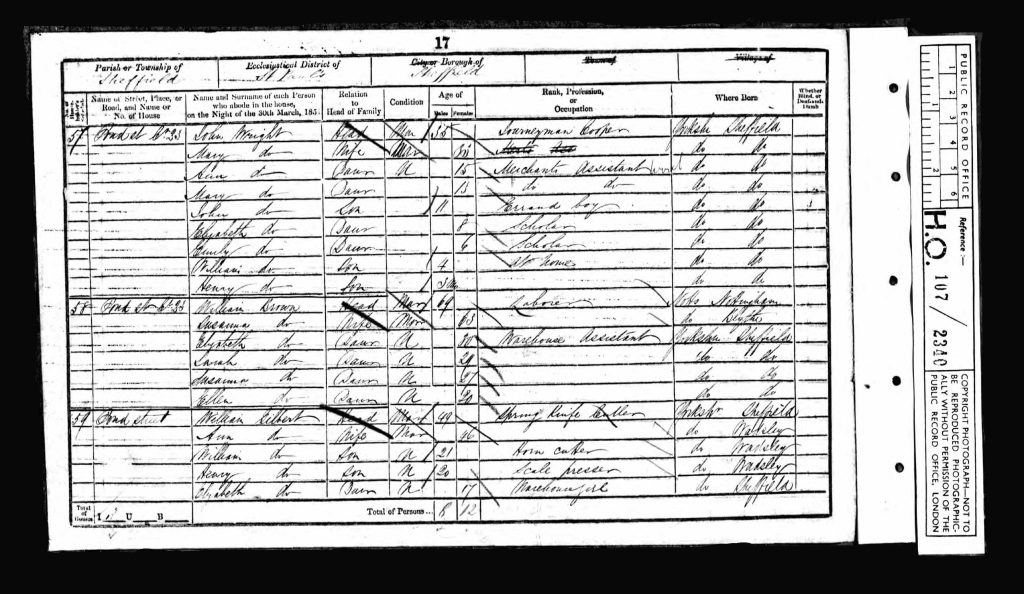
As you track your family decade by decade using the 1841-1921 census documents, you’ll notice that the questions asked by the government—and the answers your ancestors provided—changed dramatically. Understanding these key milestones and shifting classifications is essential for extracting every possible clue from the archives.
The 1841 Census: Navigating Early Limitations
While the 1841 census (catalogued under HO 107) was the first modern census run by a registration service, it comes with several frustrating limitations for genealogists. First, enumerators were officially instructed to round the ages of anyone over 15 down to the nearest five years. Second, the forms completely omitted the relationship to the head of the household, leaving you to infer whether the people living together were spouses, siblings, or servants. Finally, exact birthplaces weren’t recorded; the enumerator merely marked a “Y” or “N” to indicate if the person was born within that same county.
The 1851 Census: The Era of Standardization
Genealogical research becomes significantly easier from 1851 onwards as the 1841-1921 census questions became standardised. Recognising the flaws of the previous decade, the government standardised the data fields. The confusing age rounding was removed, replaced by a demand for the individual’s exact age at their last birthday. Crucially, the 1851 returns also began recording the precise relationship to the head of the household and the exact parish and county of birth, providing the precise geographic anchors you need.
The 1911 Census: Ancestors in Their Own Words
The 1911 census (RG 14) marks a profound, personal shift in the 1841-1921 census run. For the first time, the original household schedules were completed and signed directly by the head of the household, rather than being copied into a book by an official enumerator. This means you’re often looking directly at your ancestor’s own handwriting! This census also famously introduced the “fertility question,” which asked married women how long they’d been in their current marriage, how many children’ve been born alive to that union, and how many’ve sadly died.
The 1921 Census: Unprecedented Detail
Currently the most detailed census available to the public, the 1921 census (RG 15) represents the absolute peak of genealogical data in the 1841-1921 census portfolio. Beyond basic occupations, the 1921 returns specifically asked for the exact name of the employer, the specific place of work, and the materials the individual worked with. It also captured vital dependency data, asking for the number and ages of living children under 15 for both parents, providing an incredibly clear picture of household dynamics right after the First World War.
Step-by-Step Logic: Mapping an Ancestor Decade by Decade
Because people frequently changed addresses, jobs, and spellings of their names, tracking them across the complete 1841-1921 census span requires a systematic approach. Follow these four simple steps:
- Step 1: Start with the Most Recent Record: Always start your census journey with the 1921 release of the 1841-1921 census. Because it contains the most detail—including exact employer names and birthplaces—it provides the strongest positive identification for your ancestor.
- Step 2: Work Backward Chronologically: Move backward through the 1841-1921 census decade by decade (1911, then 1901, and so on). Working backward allows you to verify that the ages, occupations, and sibling groups align logically before you hit the more restrictive early returns.
- Step 3: Use Birthplaces as Anchors: When searching partner databases like Ancestry to verify details across the 1841-1921 census timeline, use the birthplace recorded in 1851 or 1861 as a fixed filter. Surnames and ages frequently fluctuated, but an ancestor’s birthplace remains a highly reliable constant.
- Step 4: Account for the 1841 Age Rounding: When you finally reach the 1841 entries—the earliest returns of the 1841-1921 census sequence—expect your ancestor’s recorded age to be slightly younger than in subsequent returns due to the official 5-year rounding rules. Use the household grouping to confirm you’ve found the correct person.
The Complete Decennial and Regional Research Directory
To help you successfully navigate the complex evolution of the national survey and track your ancestors before civil registration began, we’ve compiled this complete directory of specialised guides. Whether you’re trying to decode early Victorian census limitations or map an ancestor across a massive industrial county, simply choose the guide below that fits your current research roadblock:
Deep-Dive Census Guides
- 1841 HO 107 Guide: Learn how to successfully extract clues from the first modern census, including strategies for overcoming rounded ages, missing relationship statuses, and vague county birthplaces.
- 1921 RG 15 Guide: Master the most detailed census currently available to the public, featuring strategies for utilising newly added fields like exact employer names, specific workplaces, and detailed dependency data following the First World War.
- Archival Gaps Guide: A troubleshooting guide for when your ancestor seems to have completely vanished from the 1841-1921 census sheets, offering strategies to overcome physical gaps and search un-indexed records at Kew.
Regional and Parish Resources
- Lancashire Parish Registers: A complete county research guide to pre-1837 baptism, marriage, and burial records. Learn how to navigate the splintered industrial chapelries, the pull of central Mother Churches, and the regional archives of Manchester, Liverpool, and Preston.
- Yorkshire Parish Registers: Learn how to navigate the immense scale of historic Yorkshire by mastering the independent administration of the Three Ridings, outsmarting ‘Peculiar Jurisdictions,’ and utilising the Borthwick Institute for diocesan records.
- Wales Parish Registers Before 1837: Discover the centralised collections at the National Library of Wales (NLW) and learn essential strategies for outsmarting the shifting, multi-generational Welsh patronymic naming system.
- London & Middlesex Parish Registers: Uncover the pre-1837 archives of the capital using The London Archives (LMA) and the Guildhall Library, with specific strategies for navigating the 1754 Hardwicke’s Marriage Act in a densely populated city.
- Parish Chest Records Beyond the Register: Step beyond standard baptisms and burials to reconstruct your ancestor’s everyday life using local Churchwardens’ Accounts, Overseers of the Poor financial relief records, and deeply detailed Settlement Examinations.
Take the Next Step in Your Research
Ready to keep your ancestral records completely organised as you trace your family across the 1841-1921 census records and order matching civil certificates? Use our specialist log to stay on top of your family tree research.
Frequently Asked Questions
Why doesn’t the 1841 census show the exact relationships between the people in the household?
The 1841 census (catalogued under HO 107) was the very first modern survey run by a registration service, and it carried several early limitations. The government forms didn’t ask for the relationship to the head of the household, meaning you’ll have to logically infer from the names and ages whether the occupants are spouses, siblings, or servants.
Why is my ancestor’s age in the 1841 census different from their birth year calculation?
Don’t worry, your math is likely correct! In 1841, official instructions required enumerators to round the ages of anyone over 15 down to the nearest five years. For instance, an ancestor who was actually 24 would be recorded as 20, so you’ll need to account for this quirk when working out their birth year.
What is the “fertility question” on the 1911 census and why is it so useful?
This was a brilliant milestone addition to the RG 14 index! The 1911 census asked married women to state exactly how many years they’d been married, how many children had been born alive to that union, and how many had sadly died, providing you with a definitive way to spot missing children in your family tree.
Why does the 1921 census show my ancestor’s exact employer and place of work?
The 1921 census (RG 15) was designed to capture unprecedented details about the workforce right after the First World War. It’s currently the most detailed survey open to the public, asking for the specific employer’s name, the workplace address, and even the precise materials your ancestor worked with.
How should I systematically search the census records so I don’t get confused by common names?
Searching randomly can lead to frustrating identity mix-ups, so you can easily track your ancestors decade by decade by following these simple steps:
1. Start with 1921: Always begin with the most recent census, as the detailed employer and birthplace data make identification much easier.
2. Work backward chronologically: Move backward exactly ten years at a time (1911, then 1901, and so on) to logically verify ages and household groups.
3. Lock the birthplace: Use the exact birth parish recorded in the 1851 or 1861 census as a constant filter, as spelling of names and ages will fluctuate.
4. Adjust for 1841: When you finally reach the earliest return, expect the age to be rounded down by up to five years, and rely on the household group to confirm the match.

Scott Hammond is an archival detective and family history researcher who turns complex historical records into simple, easy-to-follow resources. Outside of solving centuries-old mysteries, he is a dedicated husband, father of five, and an avid British & World history buff.