If you’ve successfully traced your family back to the mid-19th century, congratulations—you’ve reached the earliest reliable snapshot of the population! However, if you’re hitting a brick wall because ages don’t align with later records and relationship details are completely absent, you aren’t alone.
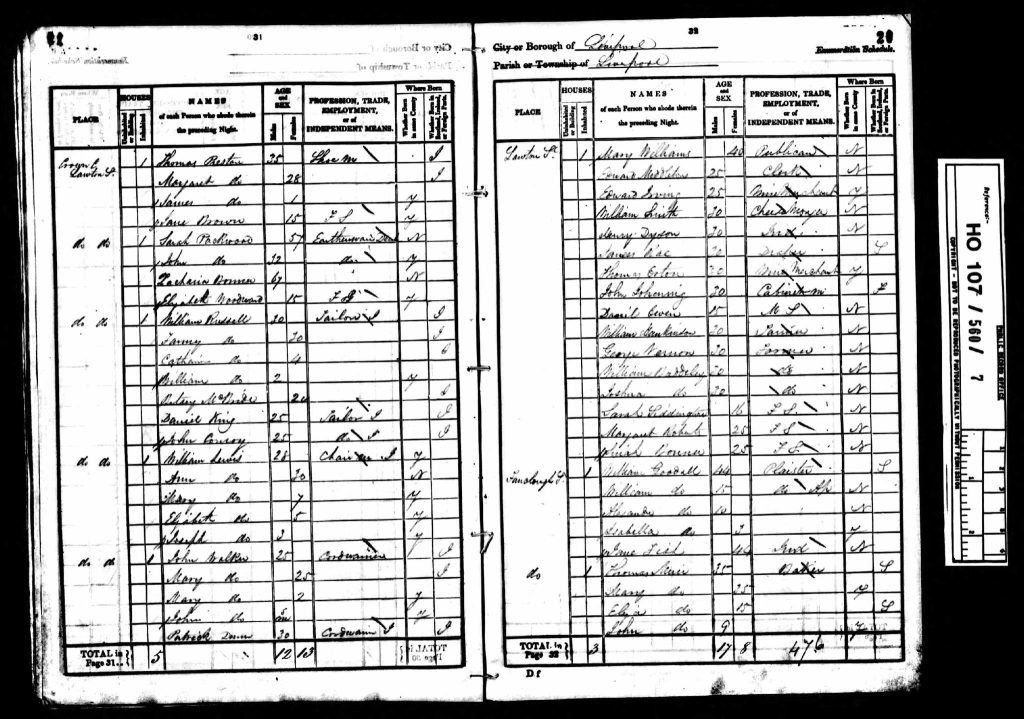
The 1841 census, catalogued at The National Archives under the Home Office series code HO 107, was the very first modern census survey run by a registration service. Because it was the first attempt of its kind, the data collected was far more basic than later returns, making the 1841 census notoriously difficult for researchers to interpret compared to the highly detailed returns of 1851 and beyond.
Table of Contents
The Age Trap: Understanding the Official Rounding Rules

One of the most frustrating obstacles in the 1841 census is the distortion of birth years. For any individual over the age of 15, enumerators were officially instructed to round their ages down to the nearest 5 years.
This means if your ancestor was 24, their age was recorded as 20; if they were 49, they were recorded as 45. Consequently, relying on the 1841 census to estimate a birth year can throw your calculations off by up to four years, making it incredibly challenging to match individuals with later records that recorded exact ages.
Solving the “Missing Data” Obstacles
Beyond rounded ages, the 1841 census presents other major hurdles: it completely lacks relationship statuses and detailed birthplaces. While the 1851 census and subsequent returns explicitly listed the precise relationship to the head of the household (such as wife, son, daughter, or servant) and the exact parish and county of birth, the 1841 census omitted these fields entirely.
To prevent overwhelm, tackle these missing details by using this simple, step-by-step logic:
- Step 1: Do Not Assume Relationships: Because the 1841 census returns only list the place, names, sex, and occupation, you must infer relationships based on household order and age. A 20-year-old woman living with a 25-year-old man might be a wife, but she could just as easily be a sister; always verify these theories against local parish records.
- Step 2: Decode the Basic Birthplace Codes: Instead of listing an exact parish, the 1841 census only recorded whether a person was born in the county of residence with a simple “Y” (Yes) or “N” (No). If they were born outside of England and Wales, look for codes like “S” for Scotland, “I” for Ireland, or “P” for Foreign Parts to narrow down your search on sites like Ancestry.
- Step 3: Work Backward from 1851: Since the 1851 census added exact birth parishes and precise relationships, use the 1851 returns (also catalogued under HO 107) as your definitive anchor. Once you establish the true facts in 1851, it becomes much easier to accurately identify the family unit in the 1841 census.
By understanding these early administrative quirks, you can systematically decode the records without getting overwhelmed by the missing pieces.
Return to the Master Hub: To see how the 1841 population returns fit into the broader evolution of British record-keeping, head back to our central 1841–1921 Census Records Overview Hub.
Take the Next Step in Your Research
Don’t let the 1841 census rounding rules derail your family tree! Use our specialist calculator to instantly reverse the Victorian rounding rules.
Frequently Asked Questions
Why doesn’t my ancestor’s age in the 1841 census match their actual birth year?
It’s incredibly common to find a discrepancy because of the strict age-rounding rules the government used in 1841. For anyone over the age of 15, enumerators rounded ages down to the nearest five years, meaning someone who was actually 29 would be recorded as 25.
What do the letters “Y”, “N”, or “S” mean in the 1841 census birthplace column?
Because the 1841 forms didn’t record exact birthplaces, enumerators used simple codes instead. A “Y” means they were born in their current county, “N” means they weren’t, while letters like “S” stand for Scotland, “I” for Ireland, and “P” for Foreign Parts.
How can I find out how people in an 1841 census household are related to each other?
Unfortunately, this census completely omitted relationship statuses, so you’ll have to make educated guesses based on the household order and ages. To avoid making mistakes on your tree, it’s best to verify these relationships by looking up local parish records or working backward from the much more detailed 1851 census.
How do I identify the right family in the vague 1841 census when they have common names?
The best way to outsmart the lack of detail is to work backward using the 1851 census as your definitive anchor. Once you’ve used the 1851 return to confirm exact birthplaces and relationships, it’ll be much easier to confidently spot and verify the same family unit in the 1841 records.

Scott Hammond is an archival detective and family history researcher who turns complex historical records into simple, easy-to-follow resources. Outside of solving centuries-old mysteries, he is a dedicated husband, father of five, and an avid British & World history buff.