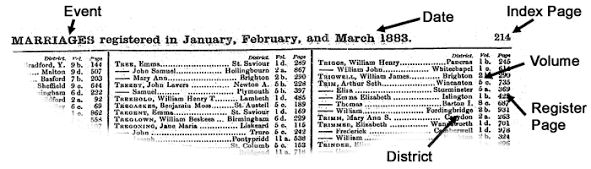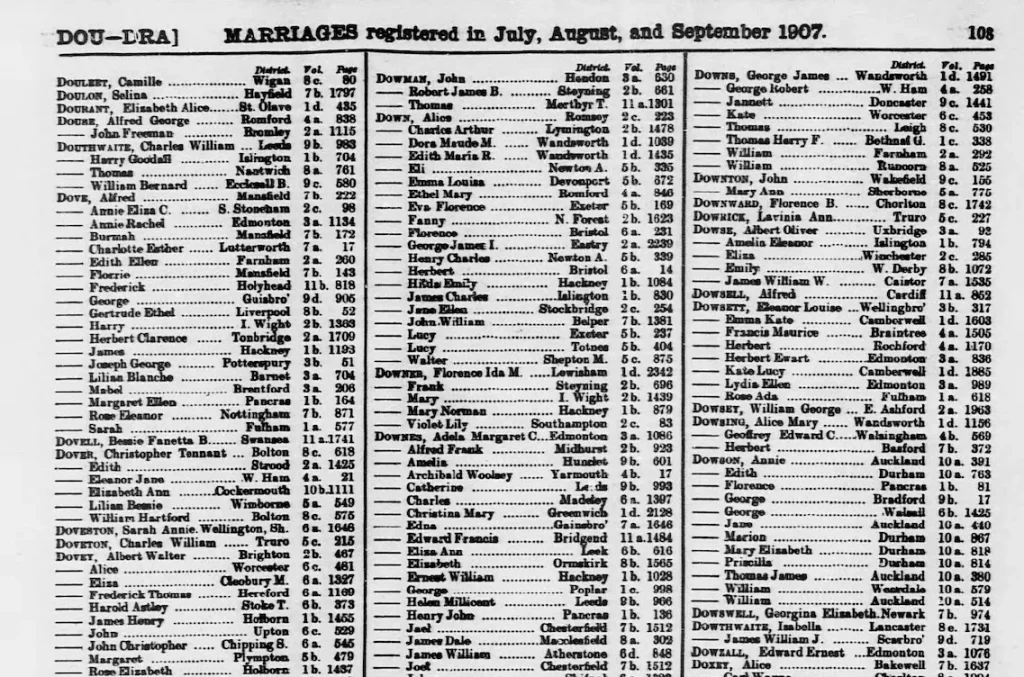
While my main Historic Marriage Certificates Strategy Guide covers the foundational “reciprocal entry” rule, understanding the theory is only the first step. If you’re researching family lines within the pre-1912 GRO marriage indexes, the spouse’s surname won’t be printed alongside your ancestor’s name. Instead, the index will simply point you to a specific volume and page number. Because a single pre-1912 General Register Office (GRO) index page usually recorded up to four individual marriages, you’ll often be faced with a list of up to four potential brides and four potential grooms grouped together on a single page.
This guide is a deep-dive, step-by-step workflow designed to help you systematically untangle those entries and confidently identify the correct spouse.
Table of Contents
Step 1: Searching Pre-1912 GRO Marriage Indexes on FreeBMD
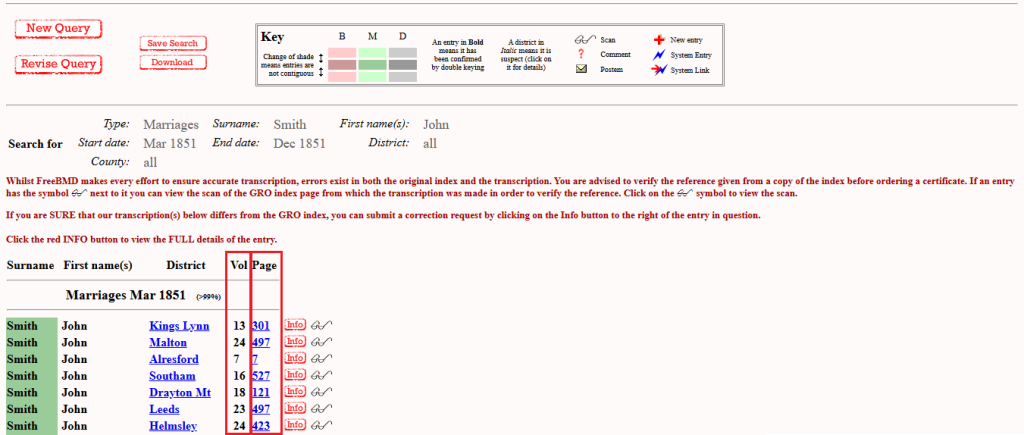
The first step to solving this puzzle is to extract the full list of people who were married on that exact same page. Begin by locating your known ancestor in the FreeBMD database and noting down the exact Year, Quarter, District, Volume, and Page number.
Once you’ve these coordinates, clear your ancestor’s name from the search form entirely. Instead, input only the exact Year, Quarter, District, Volume, and Page number you just found, leaving the First Name and Surname fields completely blank. When you hit search, FreeBMD’ll perform a wildcard page search, pulling up every single individual whose marriage was indexed on that specific page.
Step 2: Isolating the Gender Candidate
When the search results load, you’ll typically be presented with a list of up to eight people—four men and four women. To create a clean, organised checklist of potential spouses, you simply need to isolate the candidates by gender.
Through the process of elimination, if your target ancestor is a man, his bride must be one of the four women listed on that page. You can immediately disregard the other grooms in the search results and write down the names of those four women. You now have a clean, isolated checklist of potential candidates, ready for the next phase of cross-referencing!
Step 3: Cross-Referencing with Subsequent Census Records
Once you’ve your isolated list from the marriage indexes, your next move is to consult the decennial census taken immediately after the marriage year. Search the census records for your known ancestor and look for him living together with a wife.
By cross-referencing the wife’s first name, age, and birthplace with your candidate list, you can quickly eliminate the women who don’t match. Additionally, if you spot an unmarried sister-in-law or a mother-in-law living in the household, this’ll often definitively confirm which of the candidate surnames belongs to the wife.
Step 4: Utilising the GRO Online Birth Index
If navigating the pre-1912 GRO marriage indexes via census records still leaves you with multiple possibilities, your next strategy is to track the couple’s children. Turn to the official General Register Office (GRO) online portal and search for any children born in that district shortly after the marriage year.
Because the official GRO database has been reverse-indexed to retroactively include the mother’s maiden name for all births back to 1837, you can easily view this critical data point. Simply check the mother’s maiden name for any children born to the couple and match it against your candidate checklist; when it aligns perfectly with one of the women on your list, you’ve likely identified the correct spouse.
Step 5: Checking Local Parish Marriage Registers
Finally, remember that even after civil registration was introduced in 1837, the vast majority of couples continued to marry in their local church. If the local parish marriage registers for that specific registration district have been digitized and are available online, you should always check them. Viewing the original church registers will explicitly show the exact pairings of the bride and groom on the day, entirely bypassing the ambiguity of the civil index page.
Log Your Findings Before Ordering
Untangling these historical marriage indexes requires patience and logical deduction. Before you spend money on an official document, make sure to methodically log each of these elimination steps, census matches, and maiden name cross-references in your Marriage Verification Worksheet. Only after you’ve confidently eliminated the incorrect matches and isolated the true spouse should you proceed to make a final certificate order from the GRO.
Return to the Foundations: If you need a refresher on how the General Register Office structured these reference lines in the first place, head back to my core GRO Birth Index Decoding Guide to review district codes and volume ranges.
Frequently Asked Questions
How do I run a wildcard page search on FreeBMD to find a missing spouse?
Once you’ve found your known ancestor, clear their first name and surname from the search fields entirely. Leave those fields blank and input just the exact year, quarter, district, volume, and page number into the form, which’ll pull up everyone indexed on that same page.
Why does a pre-1912 wildcard search show eight names instead of just a bride and groom?
Back then, the GRO typically grouped up to four separate marriages onto a single indexed page. This means your search’ll usually bring up four grooms and four brides, so you’ll need to sort through the list to find the correct match.
How can the next census help me narrow down my list of potential spouses?
Simply find your known ancestor in the census taken just after the marriage to see who they’re living with. You can then check the wife’s first name, age, and birthplace against your candidate checklist, or look for any in-laws in the house to confirm her maiden name.
Can searching for the couple’s children help me identify the correct wife’s surname?
Yes, it’s a brilliant strategy! Just search for their children on the official GRO online portal, which has been retroactively updated to show the mother’s maiden name for all births back to 1837, and match that name against your candidate list.
Why should I bother checking local parish church registers for a civil marriage entry?
Even though civil registration started in 1837, most couples still chose to marry in their local church. Checking the original parish registers is a fantastic shortcut because they’ll explicitly show the exact pairings of who married whom on the day, entirely bypassing the guesswork of the civil index page.

Scott Hammond is an archival detective and family history researcher who turns complex historical records into simple, easy-to-follow resources. Outside of solving centuries-old mysteries, he is a dedicated husband, father of five, and an avid British & World history buff.