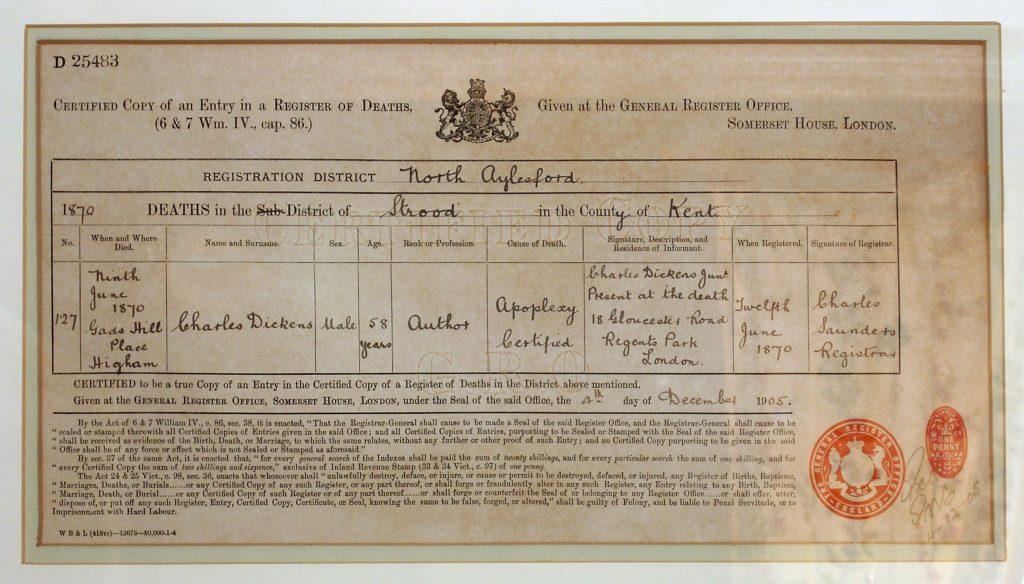
If you are researching ancestors in England and Wales, you likely already know that civil registration—the government’s system of recording vital life events—began on 1 July 1837. Since that date, the General Register Office (GRO) has kept all certificates of births, marriages, and deaths.
Finding a certificate often starts with searching the historical marriage index, which is available on volunteer-driven sites like FreeBMD as well as commercial platforms. But what happens when you find your ancestor in the index, but you don’t know who they married? Finding the spouse can feel like searching for a needle in a haystack, but by understanding exactly how the GRO compiled these indexes, you can crack the code.
Here is your authoritative guide to confirming a spouse using index data alone.
Table of Contents
1. The GRO “Reciprocal Entry” Rule
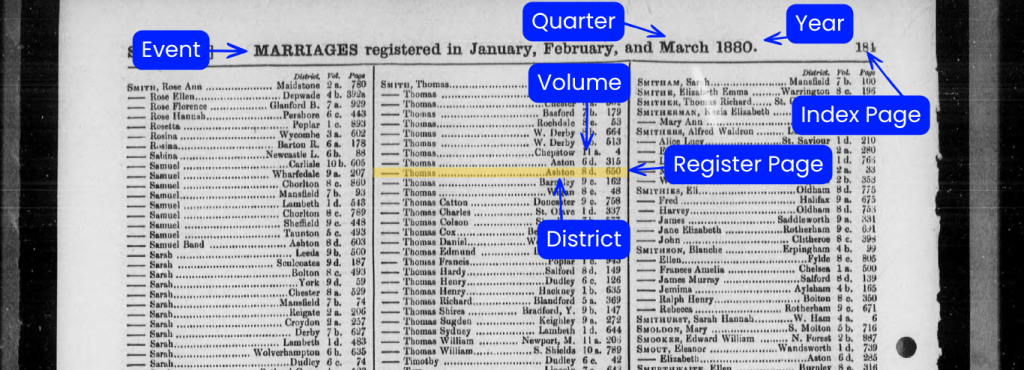
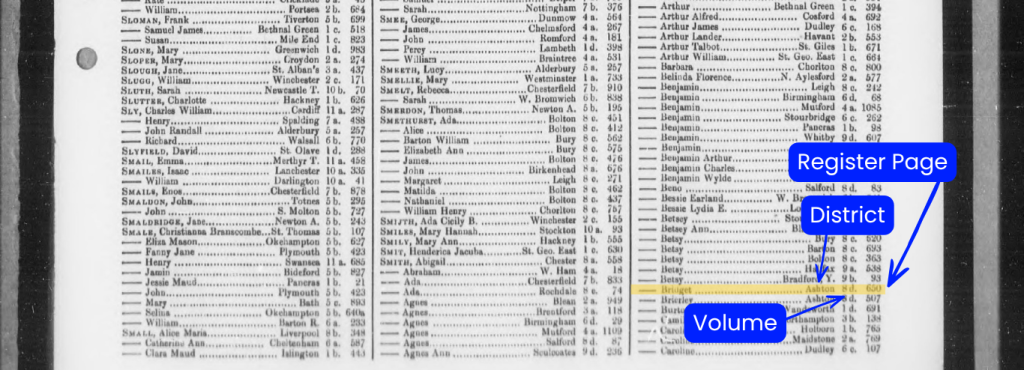
Ashton 8d 650)—this shared coordinate is the reciprocal entry rule in action.Every official marriage certificate from 1837 onward can be ordered from the General Register Office or a local register office. To organize the massive volume of certificates, the GRO instituted a highly structured indexing system.
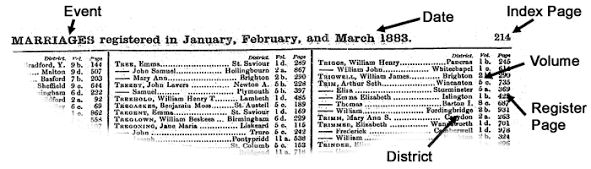
The secret to uncovering a missing spouse within the marriage index lies in the “reciprocal entry” rule. When a marriage was registered, the event was logged under a specific Year, Quarter (March, June, September, or December), Registration District, Volume number, and Page number. Because a marriage intrinsically involves two people, both the bride and the groom were indexed under the exact same Quarter, District, Volume, and Page.
This means that if you have found your target ancestor’s index entry, you already hold the precise locational coordinates for their spouse. You just need to find the matching entry.
2. The September 1912 Timeline Shift
How difficult it is to find that matching entry depends entirely on when the marriage took place.
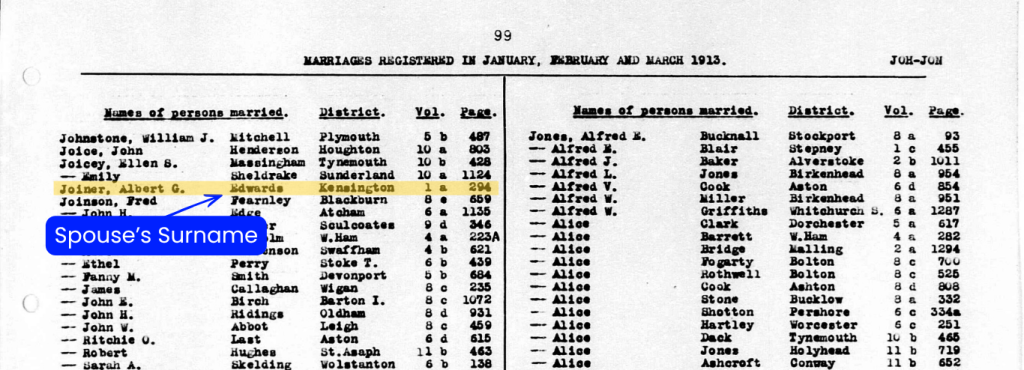
For the first 75 years of civil registration, the official marriage index listed only the individual’s name, the district, the volume, and the page. However, in the September 1912 quarter, a major shift occurred: the GRO began printing the surname of the spouse directly in the index alongside the primary individual’s name.
- Post-1912 Marriages: If your ancestor married during or after the September 1912 quarter, identifying the spouse is effortless. The spouse’s surname is listed right in the index entry, allowing you to easily search for a matching marriage entry in that same quarter/volume/page with that specific surname.
- Pre-1912 Marriages: If your ancestor married between 1 July 1837 and June 1912, the spouse’s surname is not listed. You will have to manually cross-reference the page numbers to narrow down the candidates.
3. How to Cross-Reference a Pre-1912 Marriage Index
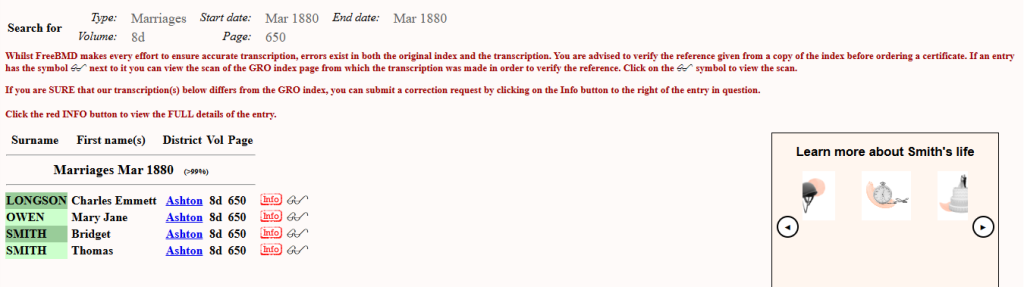
For marriages prior to the 1912 shift, a single GRO index page reference usually points to four individual marriages (meaning eight names: four grooms and four brides).
To isolate your ancestor’s spouse, follow this step-by-step logic using FreeBMD, which is highly recommended for searching birth, marriage, and death indexes from 1837 onwards:
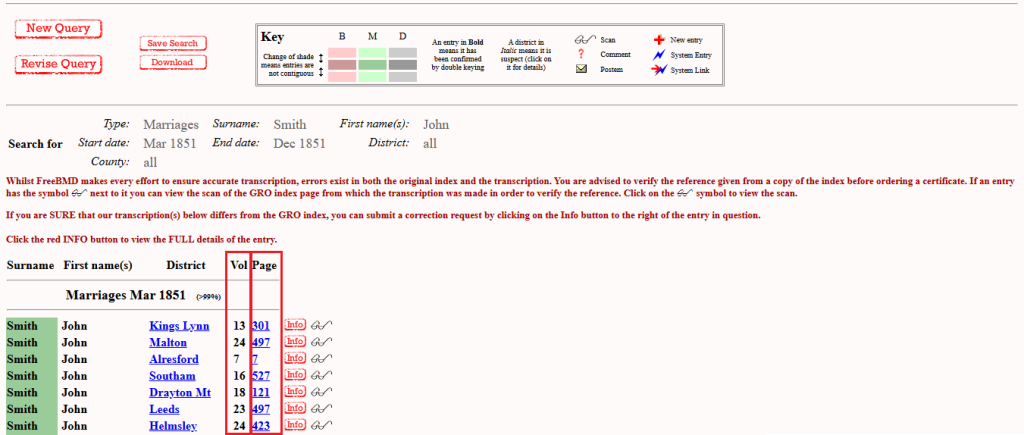
- Step 1: Locate Your Ancestor: Search for your known ancestor on FreeBMD. Note the exact Year, Quarter, District, Volume, and Page.
- Step 2: Run a Wildcard Page Search: Clear your ancestor’s name from the search form. Instead, input the exact Year, Quarter, District, Volume, and Page number you just found. Leave the First Name and Surname fields completely blank.
- Step 3: Review the Results: Hit search. FreeBMD will pull up every individual indexed on that specific page. Usually, you will see a list of up to eight people (four men and four women).
- Step 4: Process of Elimination: If your ancestor is a man, his bride is one of the four women on that list. To figure out which one is the correct spouse, you must cross-reference this list of candidates against other records. Look for the candidates in census records, search for children born with the mother’s maiden name matching one of the women, or check local parish registers if the family attended church.
4. Track Your Findings with My Free Worksheet
Cross-referencing up to four potential spouses requires careful organization. To ensure you don’t lose track of your candidate lists, we’ve created a straightforward tool to help you document your search.
Download my free “Marriage Verification Worksheet” today to easily log your ancestor’s Quarter, Volume, and Page details, track your potential spouse candidates, and confidently eliminate incorrect matches until you find the right one!
Mastering the Basics: If you’re struggling to decode the registration details on your marriage index entry, make sure to check out my complete GRO Birth Index Decoding Guide. Understanding how the state organized its volume, page, and district codes is the foundational key to unlocking all civil registration records!
Frequently Asked Questions
How can I find out who my ancestor married if the index only lists their name?
You can use the GRO’s “reciprocal entry” rule, which means both the bride and the groom are always indexed under the exact same year, quarter, district, volume, and page number. By searching for that specific page reference rather than a name, you’ll uncover a list of everyone who married on that page, which will include the missing spouse.
Why does my ancestor’s pre-1912 marriage index entry leave out the spouse’s surname?
That’s completely normal for the era, as the GRO didn’t print the spouse’s surname in the index books during the first 75 years of civil registration. This helpful shortcut wasn’t actually introduced until the shift in the September 1912 quarter, so for any marriages before then, you’ll have to cross-reference the page numbers manually.
I did a page search and found eight different names—how do I know which one is the right spouse?
Because each historic index page usually covers four separate marriages, you’ll typically be left with four potential brides and four potential grooms. To narrow this down, you’ll need to use a process of elimination by cross-referencing those candidates against other documents, like census records or children’s birth indexes.
Can I order a marriage certificate directly from The National Archives?
No, you can’t view or order individual vital records there. Every official marriage certificate from 1837 onwards must be ordered directly from the General Register Office (GRO) or the local register office where the ceremony took place.

Scott Hammond is an archival detective and family history researcher who turns complex historical records into simple, easy-to-follow resources. Outside of solving centuries-old mysteries, he is a dedicated husband, father of five, and an avid British & World history buff.