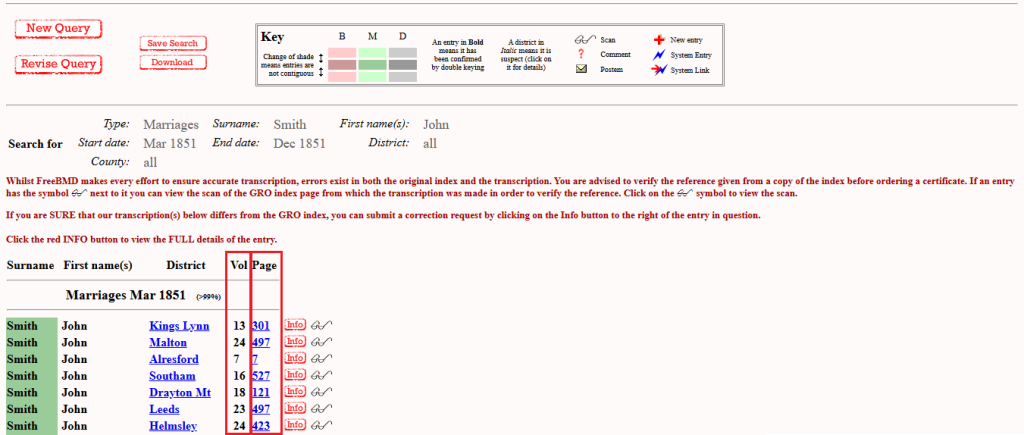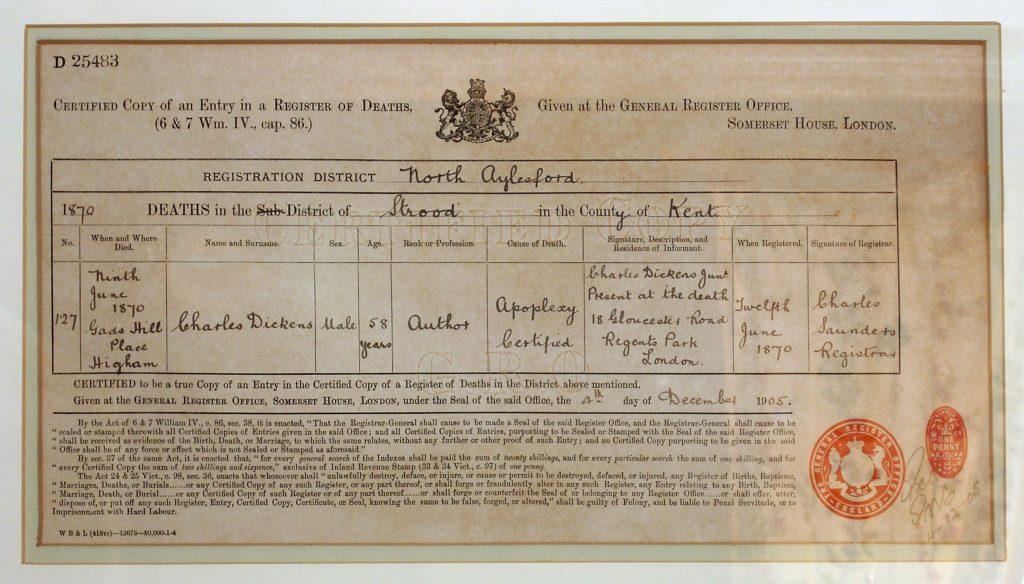
Civil registration of births, marriages, and deaths in England and Wales began on 1 July 1837. Since that crucial date, every registered vital event has been added to the GRO birth index, but it is important to remember that these original certificates cannot be viewed or ordered at The National Archives. To get a copy, you must obtain it directly from the General Register Office (GRO) or the relevant local register office.
When you search the official GRO birth index or look for marriage, and death indexes on websites like FreeBMD, Ancestry, or Findmypast, you will uncover an index entry. This entry is not the certificate itself; rather, it is a specialized reference code that the GRO uses to locate your ancestor’s physical record in their massive archive. Understanding how to read this volume and page system is critical to ensuring you order the correct document.
Table of Contents
The Anatomy of a GRO Birth Index Entry
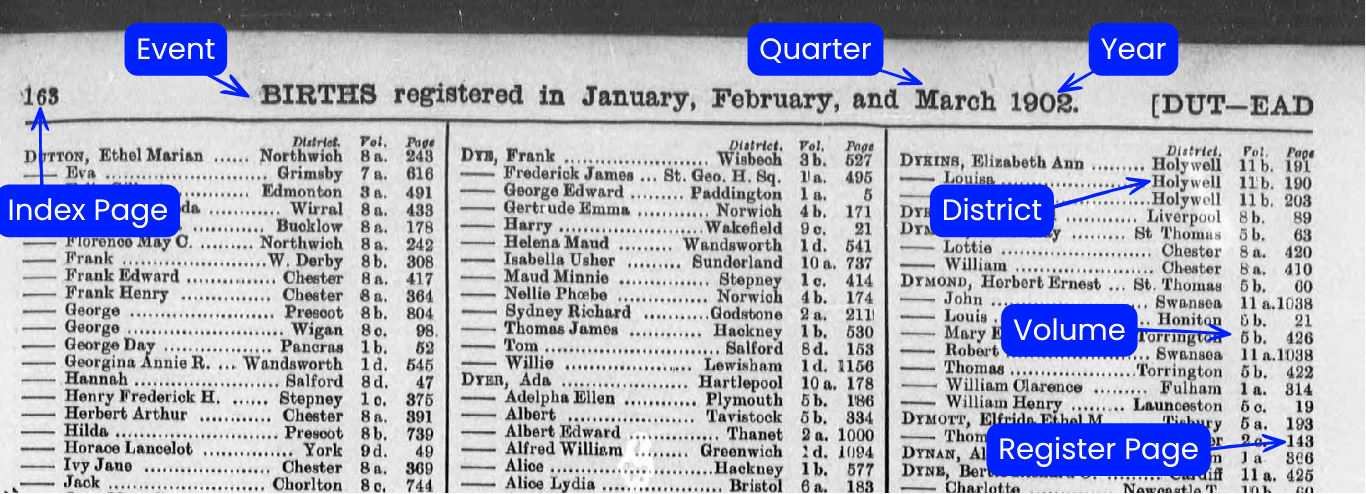
To successfully order a certificate, you need to extract four critical pieces of information from the index. You can do this by following these 3 easy steps:
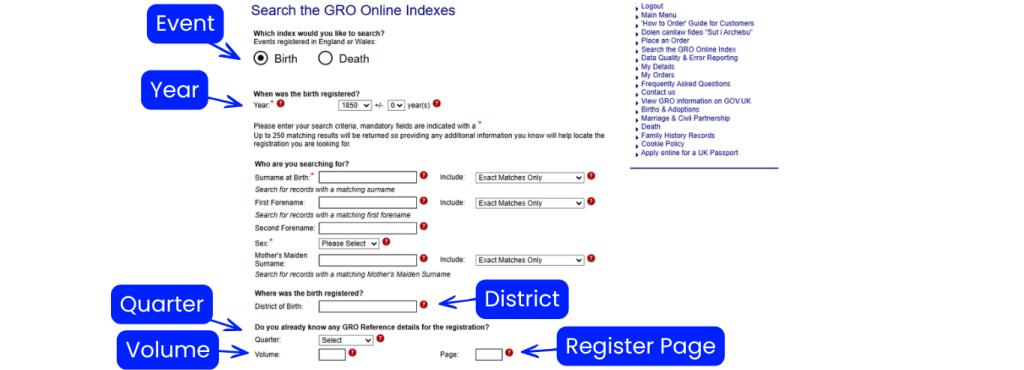
1. Identify the Year, Quarter, and District
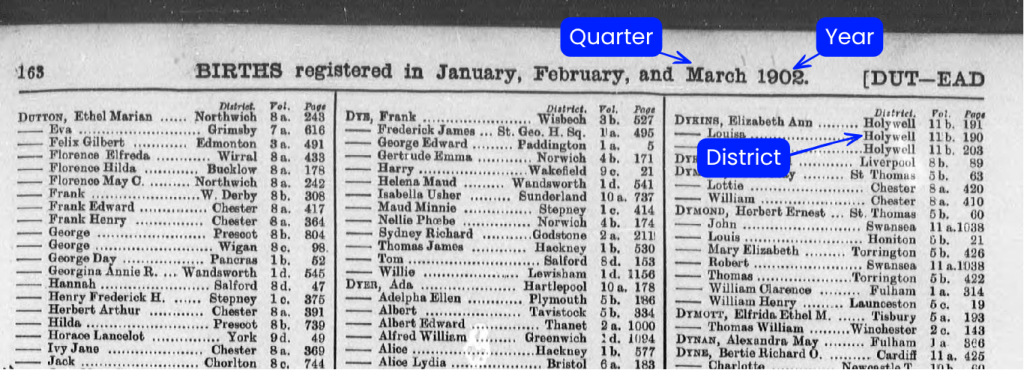
First, look at when and where the birth was recorded.
- Year and Quarter: The GRO didn’t index events by the exact day they happened. Instead, they grouped registrations into four quarters: March (covering January to March), June (April to June), September (July to September), and December (October to December). Pro-tip: Because parents had 42 days to register a birth, an ancestor born in late March might not appear until the June quarter GRO birth index.
- Registration District: England and Wales were divided into hundreds of registration districts. Pinpointing the correct district is the best way to distinguish your ancestor from others with the exact same name.
2. Note the Volume Number
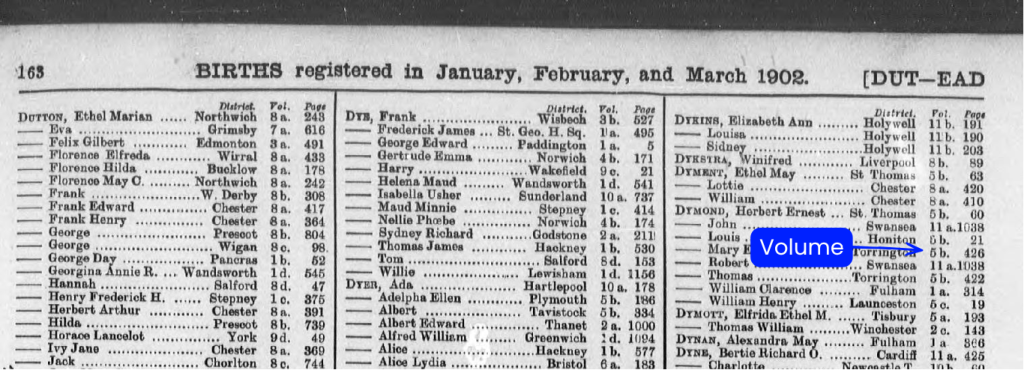
Next, locate the specific Volume number assigned by the GRO to that geographic region. In early Victorian indexes, these are often written in Roman numerals (e.g., Volume IV or Volume 4). You can use the decoder table below to map these historical volume codes back to their geographical counties.
3. Record the Page Number
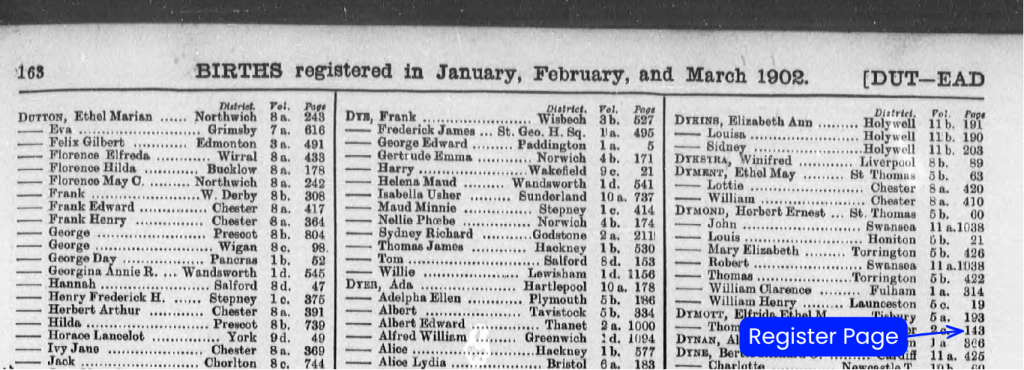
Finally, write down the exact page number within that specified volume. This represents the precise page where the local registrar copied your ancestor’s entry. Armed with the district, volume, and page, you now have the exact reference code needed to order your certificate.
Volume Number Decoder Table
To help you identify the correct superintendent registrar’s district, use this reference table to map historical volume codes back to their geographical counties:
| Historical Period | Volume Range | Covered Counties / Regions |
|---|---|---|
| 1837 – 1851 | Vols. 1 to 4 | London and Middlesex |
| Vols. 5 to 7 | Surrey, Kent, Sussex, Hampshire, Berkshire | |
| Vols. 8 to 11 | Essex, Hertfordshire, Bedfordshire, Cambridge, Norfolk, Suffolk | |
| Vols. 12 to 15 | Wiltshire, Dorset, Somerset, Devon, Cornwall | |
| Vols. 16 to 19 | Gloucester, Hereford, Shropshire, Staffordshire, Worcester, Warwick | |
| Vols. 20 to 22 | Leicester, Rutland, Lincoln, Nottingham, Derby | |
| Vols. 23 to 25 | Cheshire, Lancashire, Yorkshire | |
| Vols. 26 to 27 | Durham, Northumberland, Cumberland, Westmorland | |
| Vols. 28 | Monmouthshire and Wales | |
| 1852 – 1946 | Vols. 1a to 1d | London and Middlesex |
| Vols. 2a to 2c | Surrey, Kent, Sussex, Hampshire, Berkshire | |
| Vols. 3a to 3b | Essex, Hertfordshire, Bedfordshire, Cambridge, Norfolk, Suffolk | |
| Vols. 4a to 4b | Wiltshire, Dorset, Somerset, Devon, Cornwall | |
| Vols. 5a to 5c | Gloucester, Hereford, Shropshire, Staffordshire, Worcester, Warwick | |
| Vols. 6a to 6b | Leicester, Rutland, Lincoln, Nottingham, Derby | |
| Vols. 8a to 8e | Cheshire and Lancashire | |
| Vols. 9a to 9c | Yorkshire Ridings | |
| Vols. 10a to 10b | Durham, Northumberland, Cumberland, Westmorland | |
| Vols. 11a to 11e | Monmouthshire and Wales |
Mother’s Maiden Name & System Variations
- 1911 Onwards: The Mother’s Maiden Name column was officially added to the printed GRO birth indexes in September 1911.
- Pre-1911 Entries: On the modern GRO online portal, reverse-indexing has retroactively supplied maiden names back to 1837. If it shows a dash, it usually indicates an illegitimate birth where no maiden name was distinct from the child’s surname.
- FreeBMD vs. GRO Direct: FreeBMD tracks the printed historical index books. If you find a page suffix like “123/S” on the official GRO site, always use the GRO Direct reference for ordering, as the “S” indicates a supplemental entry.
Beware of Victorian Handwriting and Boundary Changes
When relying on a historical GRO birth index to find your ancestors, you are completely at the mercy of Victorian handwriting and the modern volunteers who transcribed it. Transcription errors are incredibly common. In 19th-century cursive, the letters “I” and “J”, or “U” and “V”, were frequently styled in ways that make them indistinguishable today. If your search yields no results, try swapping these letters or using wildcards to bypass spelling errors.
Additionally, you must watch out for boundary changes. Registration districts were not static; as populations boomed and shifted during the Industrial Revolution, district borders were frequently redrawn, split, or merged. You must keep three major legislative milestones in mind:
- 1852 Reorganisation: Overhauled the original system, moving from numeric volumes to alphanumeric codes (e.g., Vol. 8a).
- 1875 Registration Act: Enforced stricter registration timelines, altering several sub-district lines to match Poor Law Unions.
- 1929 Local Government Act: Shifted control to county boroughs in 1930, creating massive district consolidations.
Stop Wasting Money on the Wrong Certificates!
Are you tired of paying the GRO for a birth certificate, waiting weeks for it to arrive, only to realize it belongs to a complete stranger? Mastering district codes and volume numbers is the secret to ordering with absolute confidence.
Take the guesswork out of your genealogy research. Download my free “GRO District Code Decoder Cheat Sheet” today! This essential guide will help you instantly cross-reference volume numbers with their correct geographical regions and navigate tricky district boundary changes, ensuring you only ever pay for the certificates you actually need.
Once you have mastered birth records, learn how to use the official marriage index to solve the mystery of finding a missing spouse name.
Frequently Asked Questions
Why can’t I find my ancestor’s birth certificate at The National Archives?
It’s a common trap, but The National Archives doesn’t actually hold or sell these individual documents. Instead, you’ll need to order your copy directly from the General Register Office (GRO) or the specific local register office where the birth took place.
My ancestor was born in March, so why isn’t their name in the March quarter index?
Don’t worry, your search hasn’t failed! Because Victorian parents had up to 42 days to register a birth, a baby born in late March often wasn’t officially recorded until April or May, meaning they’ll show up in the June quarter index instead.
What does it mean if the Mother’s Maiden Name is just a dash in the online index?
If you’re looking at a pre-1911 record on the GRO portal and see a dash, it isn’t a glitch. It usually means the birth was illegitimate, so there wasn’t a separate maiden name to record that differed from the child’s surname.
Why does my ancestor’s index page number have a letter at the end, like “123/S”?
If you spot a suffix like “S” on the official GRO site, it simply means your ancestor’s record was part of a supplemental entry. When you place your order, make sure you use this exact GRO Direct reference rather than the standard numbers you might see on FreeBMD.
I’m completely stuck trying to find a name—could a spelling mistake be blocking my search?
It’s highly likely, as we’re entirely at the mercy of Victorian handwriting and transcription errors. In old cursive, letters like “I” and “J” or “U” and “V” looked nearly identical, so try swapping them over or using wildcards to bypass the mistake.

Scott Hammond is an archival detective and family history researcher who turns complex historical records into simple, easy-to-follow resources. Outside of solving centuries-old mysteries, he is a dedicated husband, father of five, and an avid British & World history buff.